
On 12th of December, 2025 the Ministry of Economy closed an admission of investment applications for the tender competition for a Production Sharing Agreement (hereafter – the PSA) of the metallic fossil developed and refined at the “Dobra” lithium ore plot in Kirovograd region.
Henceforth Interministerial Commission on Organising of conclusion and implementation of PSAs (hereafter – Inter-ministerial Commission) led by the Minister of Economy, Environment and Natural Resources Oleksiy Sobolev1, is to assess the applications and present its conclusions and propositions on the winner to the Cabinet of Ministers of Ukraine before the date of 12th of January 2026.
After the winner announcement the next and final stage of the tender competition is a conclusion of the PSA between the investor and the Government of Ukraine,PSA’s registration and issuing of a Special Permit for mineral resources development by the State Service of Geology and Mineral Resources of Ukraine.
EPL has tried to receive information on who really is gaining access to the main lithium deposition in Ukraine. What are the environmental implications of the PSA, whether environmental impact assessment (hereinafter EIA) is due for that project, and what share of product Ukraine will gain?
The Project on agreement conclusion of the first lithium deal is implemented in the framework of American-Ukrainian Investment Fund of Reconstruction Agreement (hereafter – the Reconstruction Fund) concluded on 30th of April 2025 between the Government of Ukraine and the Government of the USA and ratified by the Verkhovna Rada of Ukraine on 8th of May 2025. Unofficially this agreement is called “Agreement on Joint Fossil Development”.
Already after official launch of the Reconstruction Fund on 23rd of May 2025 Inter-Ministerial Commission decreed a proposition on advisability of tender competition for “Dobra” lithium plot2.
The Government supported the proposition of the Commission with a Decision of the Cabinet of Ministers of Ukraine dated 27th of August 2025 № 1059 “On Proceeding with Tender Competition on Conclusion of the Production Sharing Agreement of Metallic Fossil Developed and Refined at the Dobra plot ore” (hereafter – Decision № 1059), and decided to have an open tender competition and conclusion of the PSA at “Dobra” plot, and established competition rules 3.
The PSA covers granting of the Special Permit for geological study, including research and industrial development with further development of metallic fossil and other activities allowed for by the PSA. The PSA is to be concluded for the duration of 50 years from the date of its signing but respective parties can agree otherwise which should be stipulated in the PSA.
General area of “Dobra” plot in Novoukrayinka District of Kirovogradska region is 1706,0 hectares. The plot has got deposit of petalite-spodumen ore4 (deposits containing lithium). The PSA covers development of other minerals namely niobium, tin, rubidium, tantalum, cesium, beryllium, tungsten, aurum – all are of strategic or crucial importance in EU and are part of list of minerals for Reconstruction Fund funding.
Cited minerals are part of minerals and components of strategic and crucial importance in Ukraine. The list of these minerals and components was recently approved by the cabinet of Ministers of Ukraine in Decision dated 14th of July 2025 № 8455.
Tender competition terms make provisions for the winner to perform the following works at the plot:
1) geological survey of mineral resources and audit of plot deposit in 2,5 years;
2) report on the geological survey and submitting the report to State Informational Geological Fund of Ukraine for its further use in the framework of Ukrainian legislation;
3) submission of State Commission of Ukraine on deposit of minerals materials on assessment of lithium deposit and other minerals for verification of the deposits;
4) providing of environmental assessment for planned activity;
5) as a result of geological research, investor should make a decision on transition (or refusal to transit) to organisational activity within six month period
There are two options:
Option one – investor carries the activity on development organisation and lithium refinement within 5 years from the date of decision confirmation.
Option two – investor refuses go through with the decision and within 6 months period return Special Permit to state authorities. The Agreement is terminated.
Thus considering the terms of the tender competition environmental impact assessment on “Dobra” plot could be performed only after geological survey of lithium deposit and its validation, which might take three years. That is all geological survey including drilling, geophysical geochemical, hydrogeological methods and works on site would be conducted without EIA. There is no other procedure to consider public opinion thus excluding environmental impact assessment at stage of geological research.
The Agreement also provides that in the framework of Special Permit investor can perform research mining which is transitional stage from geological survey to fossil development and allows excavation of up to 5% of recorded deposit during three years. EIA is not required at this stage either since industrial development is a part of geological research6.
EIA for realization of the project of “Dobra” lithium plot development is only feasible after three years at best, since it is required only before performance of planned activity of lithium development and its refinement.
Investment amount and terms of distribution of the Agreement
According to terms of tender competition an amount of investment for geological survey is a minimum of 12 million of USD. An investment for development and refinement organization (primary processing) of lithium ore and other metallic fossil is a minimum of 167 million of USD. General investment amount is stipulated as a result of tender competition.
General criteria of products distribution as stipulated at point 18 of tender competition terms are as follows: all product before distribution between the state and investor is state property. Maximum share compensated to investor is 70% of general products volume till full compensation of investor’s expenses.
Hereby State’s share in profitable products (which cannot be less than 30%) has to be not less than 4% or 6% (depending on surplus of accounting cost of refundable over limit value or invertedly), not less than 4% in case of exceeding of refundable accounting costs in tax period over cost of limit value of refundable products and not less than 6%in case of exceeding of refundable products over refundable limit value for the tax period.
There is an explanation of this formula in Tax Code of Ukraine defining tax distinction in the framework of the Agreement.
Point 14.1.94 of Tax Code states: refundable products – is a part of product transferred under investor ownership as compensation of their expenses (not profit but compensation of expenses under the project). Whereas profit-making products – is part of overall products distributed between investor and the state and is established as the difference between overall products and refundable products under the framework of the Agreement (point 14.1.196 of the Tax Code of Ukraine).
Thus only 30% of products is not refundable and is subject to further distribution between the state and investor as profit-making products.
The tax period of products distribution is defined according to part 2 of the Article 19 of the Law of Ukraine “On the Agreements on Products Distribution” as quarterly (accounting period).
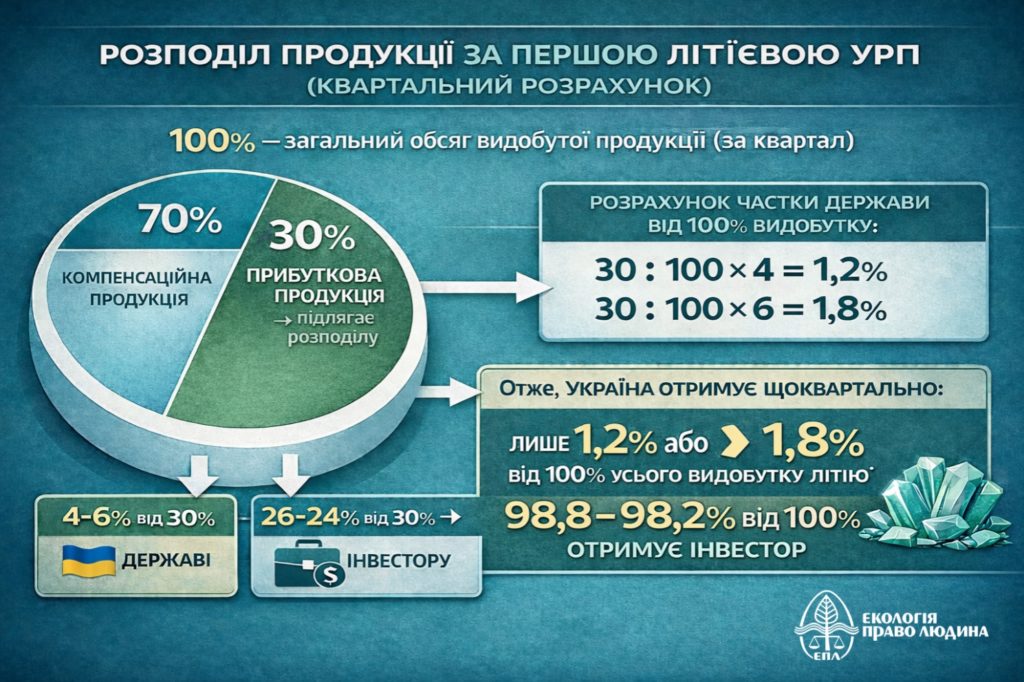
According to the terms of the first lithium agreement, products distribution will be conducted in the calendar quarter according to the formula:
100 % – overall amount of products;
70 % – refundable products transferred to investor (refundable products);
30 % – profit-making products is to be distributed between investor and the state where states share is 4% or 6%.
State’s share calculation is as follows: 30:100х4 =1,2 % or 30:100х6 = 1,8 % accordingly.
Thus Ukraine will quarterly receive only 1,2% or 1,8% of all developed lithium (100%). The investor share is 98,8% or 98,2%.
Inforgraphics for the formula
The formula is unbeneficial for Ukraine, and gives the investor an opportunity to artificially overestimate refundable expenses by including expenses not related to lithium development ore, overestimating equipment cost, other goods and services. It will prolong refund period and lessen state share in profit-making products.
There is also high risk of manipulation with the amount of products by lowering factual amount of lithium ore and manipulation with quality characteristics of products (lithium content), which would allow the investor to extend refundable share since its very beneficial to them.
Since the order of estimation of refundable expenses to be refunded with products is stipulated by the Agreement (part 5 Article 19 of the Law of Ukraine “On Product Sharing Agreements”)7 the absence of transparency and public control and no text of specific Agreement is a base for future manipulation and fraud.
In absence of any due control from the state and international audit investor can overestimate their expenses and report less products of poorer quality and Ukraine will be losing its already small share. It is difficult to accurately assess the market value of lithium products at different stages of refinement, so it would create additional risks of fraud.
Formal restriction to 70% doesn’t guarantee a fair distribution of products if there is no real control of expenses and amount of development. Since lithium is a crucial resource for Ukraine this method of distribution is detrimental. Ukraine will not only lose economical profit but simultaneously worsen environment of the area of the plot and neighbouring communities (which are not included in decision-making process on the project).
Who exactly is gaining access to key lithium deposit in Ukraine?
Financial Times8 reported Irish company TechMet has its interest in “Dobra” plot development and is planning to take part in future tender competition for Special Permit. In September 2025 deputy of the Minister of Economy Yehor Perelyghin confirmed that TechMet has submitted application for the Agreement tender competition9.
At the meeting of the USA representatives with the President of Ukraine which took place at 02.07.2025 TechMet company was represented by Volodymyr Ihnashscenko10.
The interesting part is Volodymyr Ihnashscenko being connected with the ex-minister of Energy Ihor Nasalyk 11. Volodymyr Ihnashchenko is also an owner of former “Petro-Konsalting” Ltd. as is stated in Forbes Ukraine12 article and “Rukh Chesno” article13.
“Petro-Konsaltyng” Ltd.14 (changed its name since 05.01.2022 to “European Lithium Ukraine Ltd.” and is owned by European Lithium Ltd. between years 2018 and 2023 has been having a litigation with State Service of Geology and Mineral Resources of Ukraine for the right to develop “Dobra” plot. The company insisted through several court suits that it has preemptive right to gain Special Permit for the ”Dobra” plot outside auction procedure (deposit approbation procedure). But 5 year long litigation haven’t yielded any success, the company couldn’t force State Service of Geology and Mineral Resources of Ukraine to grant Special Permit outside the auction procedure (Sixth Appeal Court Decision dated 15th of June 2023 case № 640/7500/2115).
There is one more interesting fact about the company. Yehor Perelyhin led Petro-Konsaltyng Ltd. from May 2018 to May 201916 is effective deputy of the Minister of Economy17, an expert on crucial minerals, coordinating applications drafting and implementation of decisions on organization, concluding and implementation of the Agreement.
All these nonrandom coincidences may confirm the TechMet is only a cover-up for a real player European Lithium Ukraine Ltd., which after failed litigation has changed its strategy from litigation to political lobby. In this scheme the Agreement format is used as alternate way to gain the access to the plot bypassing auction competition.
Rights for resources development granted in the framework of the Agreement could be transferred to third parties (as is stated in Subsoil Code of Ukraine and the Law of Ukraine “On Products Sharing Agreements”), so it could be legally granted to “right company”.
One can see that declared mineral resources deposits in Ukraine are understudied and there is need to study them better. There is need in multimillion investments and modern technologies for geological research, fossil development and further refinement. There are geological properties which allow only for mining18, of lithium hence construction of mines and refinement (to spodumene or petalite concentrated product) facilities is of essence.
As for the environment there is no research on lithium development and refinement on environment and its environmental risks.
Lithium could be damaging to the environment through water and air contamination, soil degradation which occurs during excavation and refinement of the metal. Lithium release into environment may have negative impact on flora and fauna destroying ecological equilibrium. Development of natural resources and advance of economy are of more importance to the state than environmental safety and balance.
Ukraine should ensure transparency of the Agreement, implementation of provisions of the Aarhus Convention and ensure public participation in decision-making considering the Agreement, since the endeavor to switch over to clean energy one risks to get a business negatively impacting environment as it is with wind farms at Carpathian highlands.
4 chrome–extension://efaidnbmnnnibpcajpcglclefindmkaj/https://www.geo.gov.ua/wp–content/uploads/2021/03/%D0%94%D1%96%D0%BB%D1%8F%D0%BD%D0%BA%D0%B0-%D0%94%D0%BE%D0%B1%D1%80%D0%B0.pdf
10 https://www.president.gov.ua/news/volodimir–zelenskij–zustrivsya–z–predstavnikami–amerikanskog-98801
11 https://zakon.rada.gov.ua/rada/show/v0688732-16#Text
12 https://forbes.ua/money/tyazhelyy–metall–chto–meshaet–naladit–dobychu–litiya–v–ukraine-04022021-961
