
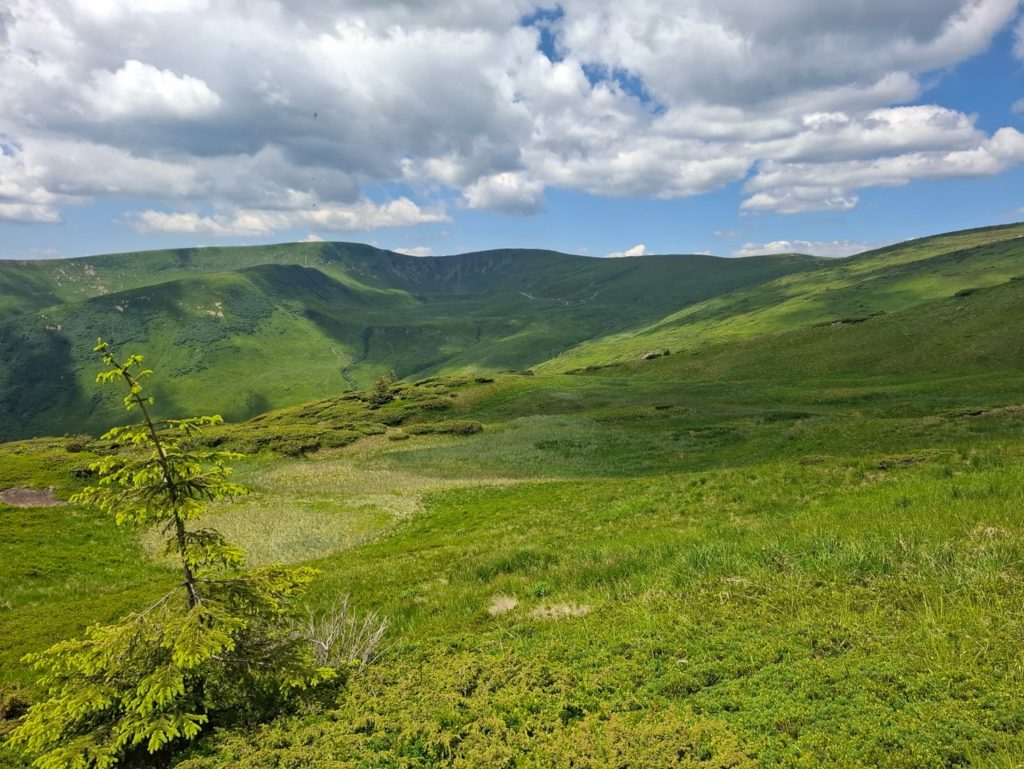
On June 25-27, EPL team conducted a survey of the Svydovets mountain range in the Carpathians. This range still has some of the best-preserved natural complexes in the Ukrainian Carpathians, an extremely interesting geological structure and lakes of glacial origin, which have the status of hydrological monuments of nature. Svydovets is home to a wide variety of Red Book species of plants and animals. This range has repeatedly been under threat of destruction: initially, it was planned to build a ski mega-resort like “Bukovel”, the next proposal was to cover Svydovets with wind power plants. Both ideas look equally disastrous for the mountains. Svydovets has also recently been the scene of scandals related to the destruction of nature by jeepers, quad bikers, motorcyclists and “tourists” in trucks converted for passenger transport.
To preserve this unique ecosystem from the encroachments of unscrupulous businesses of various levels, EPL has been conducting field research for the third year in a row to identify the habitats and growth of rare and endangered species with the aim of creating the Free Svydovets National Nature Park.
The highest ski resort in Ukraine, Dragobrat is already located on Svydovets and the resort is gradually expanding due to construction of new hotels, the tourist load is increasing in winter and summer. The road to the ridge is visible from afar as a long wound with erosion hollows, which has not healed for years. The first point is the so-called “Bridge”, a saddle between the mountains, where the cable car ends. Nearby is Mount Stiр. A powerful water spring has always flowed from the southern slope of Stih, from which tourists stocked up on water for long journeys. This year it is dry, some water only seeps through the ground. Tourists passing by say that some hotel took the water. Therefore, there is no more of it. Whether this is really so, we have not been able to verify. But the lack of water here may pose a threat to hikers who are counting on replenishing their water supplies here. This year is especially dry, the snowfields on the ridge have melted (previously they could be seen in August). Only the remains of one were found in the Vorozheska Basin.
We are heading along the traverse past Karaciuniescu. We are overtaken by heavy vehicles with “tourists”, who are usually heading to the two most popular viewing points – the viewing platform of the high-mountainous karst lake Vorozheska and the shores of Lake Herashaska. The scars of the mountains are striking – strips of vegetation and soil destroyed by SUVs, trucks, ATVs and motorcycles. Every year they become larger, because no one maintains the road: as soon as it is driven to the point of impossibility of movement, another one is laid on the side. And it takes tens and even hundreds of years to heal, and that is on the condition that no more vehicles pass through these areas.
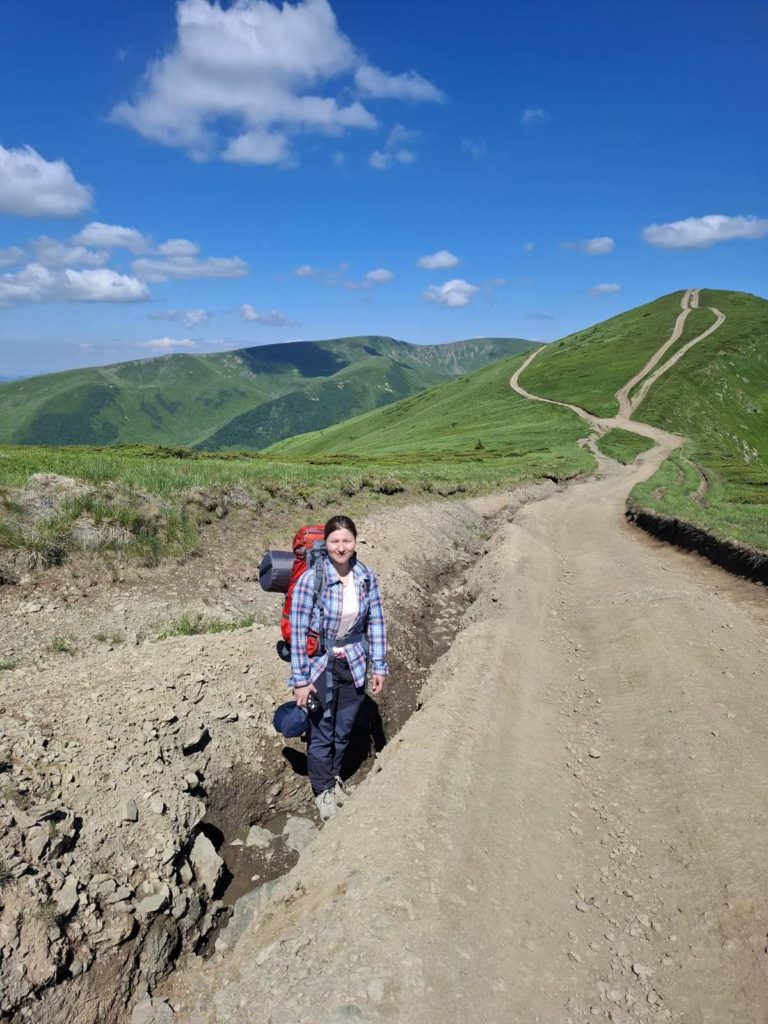
Erosion hollow from uncontrolled traffic on the Svydovets Ridge
We bypass the Velykiy Kotel mountain. Our expeditions have worked here in previous years. On the way, we visit the “newt” lakes near the route – a whole cascade of lakes and numerous springs. The lakes are abundantly populated by Red Book newts – Alpine and Carpathian. On the way, we note numerous Red Book plants, such as the pointed gentian and orchids. These are important high-altitude wetlands that need protection and preservation.
Next, we pass by the observation deck on Lake Vorozheska, which rises several hundred meters above the lake. Here we encounter jeepers: they are making photos with mountains in the background, a drone flies overhead, an SUV stands to the side. There is a pile of garbage on the observation deck: bottles, candy wrappers, and cigarette packs. We watch to see if the so-called jeep tourists will pick up the garbage. They didn’t. Kateryna suggests that we should pick up the garbage. I refuse, emphasizing that we can pick it up after we return, but for now, as hikers, who still have 20 km of road ahead, it’s better to save our strength. The lake below is blue, cold, and inaccessible. A little higher than it, we see a small white speck of snow. This is a snowfield consisting of firn – compacted, granular snow. A feature of this snowfield in previous years was that it melted completely very rarely, only in some of the warmest years. Its area was hundreds of square meters. But even in the warmest years, it usually melts completely only in August. This year, there is very little snow at the bottom, about 3 meters wide and long. This is the entire snowfield as of the end of June. Unfortunately, in conditions of hot weather and climate change, it will not last until August. Preserving the snowfields as long as possible is important for preservation of the lake: its meltwater feeds it. If the snowfield melts completely, the meltwater changes to underground, warmer water. As a result, the ecological balance in the high-mountain lake is disrupted: the amount of dissolved minerals and organic matter in the water increases, and algae grows. The fauna of the reservoir also undergoes changes. For such a vulnerable system, these changes can have catastrophic consequences.
We move on. Here we are overtaken by numerous GAZ-66s and various SUVs and motorcycles. Everyone is rushing to Gereshaska, raising clouds of dust around. We do not go to Gereshaska. There are as many people near the water as at some suburban reservoir near a big city. Cars are parked right next to the water. Even from a distance, it is noticeable that the lake is on the verge of survival. The events around it have recently been the subject of heated discussion on social networks: some jeep simply drove through it. Crowds of people walk into the lake up to their knees. Most people do not go further because water is really cold. But for such a lake, even this can have serious consequences: organics and chemicals from creams and other cosmetics, dirt from roads, fuel, lubricants and dirt from car wheels get into the lake. This is certain death for the lake’s inhabitants. In addition, enormous harm is caused by those who think of washing themselves with detergents in such high-mountain lakes. Such actions can also kill life here, in the reservoir of the subalpine zone that is a hydrological monument of nature, an object of the nature reserve fund of Ukraine, protected by current legislation, and also has a protection zone in accordance with the Water Code of Ukraine. However, it demonstrates the depth of the problem of the lack of a system of proper control and responsibility for violations of environmental legislation.
Having gone around the traverse of Gereshaska and admired Lake Apshynets from the ridge, we head to one of our goals – Mount Troyaska. Last year, we discovered a wind measurement tower on it that was installed in preparation for the construction of wind turbines for a wind farm. There was a trailer with a guard nearby. The trailer can be seen from afar, but the mast is not visible. We go up the mountain and observe the picture, which is claimed by supporters of wind energy in the mountains to be care about nature: dug trenches for reinforcing hooks, the remains of the mast foundation, disturbed overturned soil, which is so unique that it takes hundreds of years to restore it! The metal base of the mast, an abandoned wagon and mountains of garbage: bottles, cans, etc. There is much more garbage here than on tourist routes where hundreds of people pass. There is no guard. We assume that nature, by the force of the wind, demolished it in the winter or the developers of wind mills refused to implement the absurd idea. They just forgot to clean up after themselves. Well, the amount of garbage here is beyond the power of hikers. We need to involve the State Environmental Inspectorate and oblige the culprits to clean up after themselves. By the way, the local amalgamated community could do the same. Last year, we discovered the growth sites of the Red Book species of Huperzia selago (L.) at the site of the tower’s construction. We take pictures of the situation and move on.
From Ungaraska to Tempа and back
The next mountain is Ungaraska. On the traverse of Ungaraska we find two feathers. Ornithologists later determined that this is probably a golden eagle feather. It should be noted that mass tourism practically disappears after Hereshaska. We met only two small groups of motorcyclists and literally three pedestrians. There are also fewer traces of erosion from transport on the mountains. But on the ridge, semi-free herds of horses graze, a little lower – flocks of sheep. And here the kingdom of Red Book plants really opens up around us: fields of narrow-leaved narcissus – a species listed in the Red Book of Ukraine. Matyaska, Mala Krutiaska and Velyka Krutiaska are literally dotted with these plants. We are a little late for the period of greatest flowering, but we can still see thousands of flowers around. We also recorded the presence of other protected plants – gentian, stemless gentian, speckled gentian, as well as numerous very interesting butterflies – oak butterflies (thanks to our fellow scientists who helped identify them!) The presence of such ecosystems with such a huge number of protected species is more than a reason to create a protected area.
Narrow-leaved narcissus, Red Book of Ukraine
How can Svydovets be protected? The best protection is granting it a protective status. But what kind of protactive status? In our opinion, the best solution would be to establish a national nature park on Svydovets. First, national parks are nature conservation, recreational, cultural and educational, scientific and research institutions of national importance, created for the purpose of preserving, recreating and effectively using natural complexes and objects that have special nature conservation, health, historical, cultural, scientific, educational and aesthetic value.That is, for Svydovets, this will allow both the development of tourism and the preservation of nature. Secondly, national parks have zoning, which allows the introduction of separate regimes for individual territories. National parks can create a reserve zone, a zone of regulated recreation, a zone of stationary recreation (where, for example, hotels, parking lots, etc. can be located) and an economic zone. Thirdly, national parks have their own security service, the task of which is to prevent violations of protected territories. Lower-ranking protected areas – for example, protected tracts, reserves, natural monuments – do not have such security services. Fourthly, which is important for local budgetary development – national parks are financed from the state budget. At the same time, taxes are paid to local budgets. |
The next point is Mount Tempa, the extreme point of our expedition to Svydovets. The highest beech forests in the Eastern Carpathians can be found under the mountain on the southern side.
What are the results of our survey? We found a large number of Red Book species, for the preservation of which it is necessary to create protected areas. All habitats and points have been recorded, work on ensuring protection is ahead. We saw what consequences are caused by jeeping in the Carpathians and why it is necessary to regulate the use of off-road vehicles in natural areas. We got convinced that only establishment of a high-level nature conservation object, for example, a national park, will ensure real preservation of the mountains. Another critically important conclusion is that there should be no wind power generators on Svydovets. Why? Because the Carpathians are only about 4% of the area of Ukraine, which are extremely important in terms of nature conservation and ensuring recreation and recovery of citizens. Because wind generators can be placed on agricultural lands of the plain part of Ukraine, which occupy more than half of the territory of our state, without any special harm to nature. Because the unique landscape of Svydovets and the opportunity to contemplate the natural grandeur of the mountains are a separate value. Because the capital costs of building a wind farm in the highlands are so high that talks about one or two generators is a blatant lie, because it is possible to economically recoup such costs only if many generators are placed, which will completely destroy the unique nature of the highlands, as is currently happening in the Runa valley. Because talk about compliance with environmental legislation by developers is just talk, which in practice turns into destroyed soil cover and mountains of garbage in the mountains, as, for example, on the Troyaska.
Tomorrow we will return along the route we have traveled. It will have the same scorching sun, the same dust from SUVs, bags and bottles thrown by tourists from SUVs, which we will carry on foot, out of the mountains to the nearest garbage dumps below. It will have children who traveled the mountains on foot, for which they and their educators have immense respect and gratitude, and healthy men on ATVs who rushed past the children, waving their hands and not knowing that in response the children were shouting at them “weaklings!”. Walking this path, we will gain even more determination to protect the mountains from barbaric destruction that can be hardly called by the word “civilization”.
P.S. According to the results of the visit, EPL not only removed the garbage from the ridge, but also prepared an appeal to the State Environmental Inspectorate of Ukraine regarding the illegal disturbance of the soil cover and littering of Mount Troyaska by representatives of the wind energy industry. EPL also continues writing the justification for establishment of the Free Svydovets National Nature Reserve.
