On March 12, 2026, a round table entitled “Environmental Governance in Ukraine: Capacity Test and Reform Prospects” was held in Kyiv at the Ukrinform press center. The event was organized by the International Charitable Organization “Environment-People-Law” (EPL). The meeting took place in a hybrid format—both offline at the press center and online—allowing a wide range of stakeholders to join the discussion.
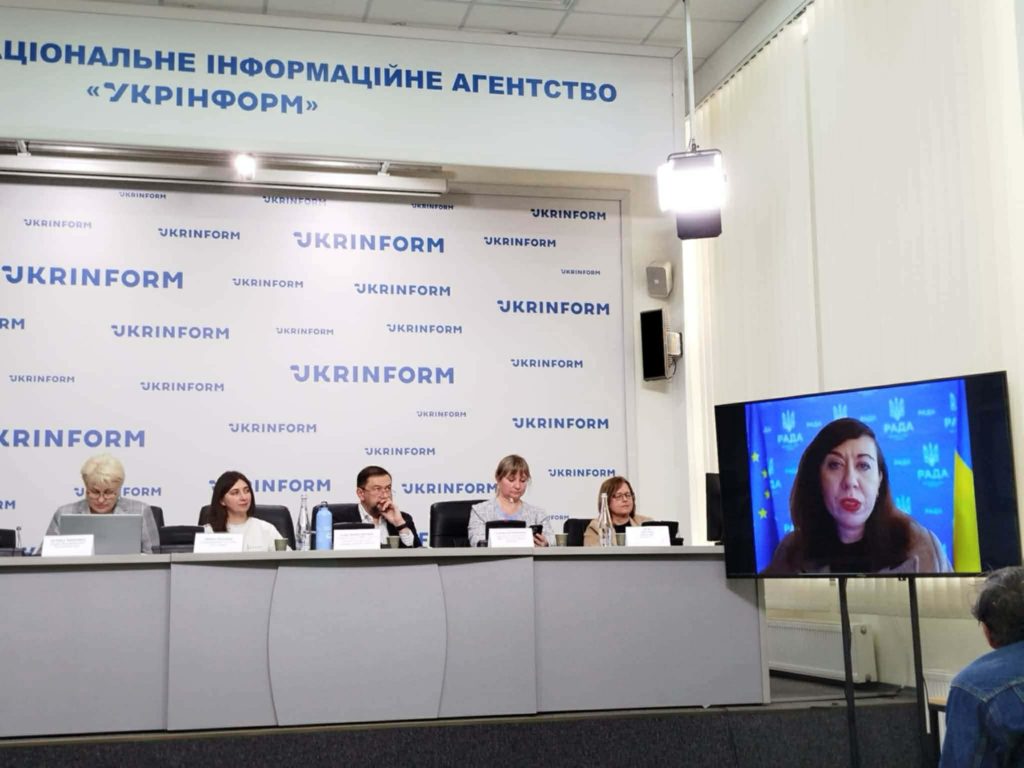
During the meeting, Members of Parliament, representatives of government authorities, and the civil society sector discussed the current institutional capacity of Ukraine’s environmental management system, key reform challenges, and potential ways to strengthen environmental governance amidst the war and European integration.
The central theme of the meeting was the presentation of EPL’s new policy paper “Institutional Capacity in the Field of Environmental Conservation: Assessment, Challenges, and Prospects.” The document focuses on analyzing the effectiveness of Ukraine’s environmental governance system and assessing the prospects and pace of fulfilling tasks under Chapter 27: “Environment and Climate Change” of the EU acquis in the process of Ukraine’s accession to the European Union.
During the presentation, the policy paper‘s authors shared key findings and recommendations for reforming and strengthening the institutional capacity of government authorities in environmental protection and conservation, within the context of Ukraine’s post-war reconstruction and its EU integration obligations. The policy paper analyzes the institutional capacity of authorities at various levels: central executive bodies, regional military administrations, and local self-government bodies.
The document provides an analysis of the human, financial, and organizational resources of the institutions responsible for implementing environmental policy, as well as the level of coordination between different governance levels.
The event was opened by Olena Kravchenko, Executive Director of EPL. In her opening remarks, she emphasized the importance of a systemic reform of environmental governance in Ukraine, the training of professional staff, and the formation of strong and independent institutions capable of effectively implementing state environmental policy. According to her, without a proper institutional architecture, sufficient human capacity, and clearly defined powers for government authorities, it is impossible to ensure an adequate level of environmental protection and the fulfillment of Ukraine’s EU integration obligations. She also outlined the goal of the meeting: to discuss the research findings and the current state of institutional capacity of government bodies in the field of environmental conservation.
Oleh Bondarenko, Chairman of the Verkhovna Rada Committee on Environmental Policy and Nature Management, addressed the participants with a welcoming speech. He emphasized that the reform of state environmental management is a necessary condition for Ukraine to fulfill its EU integration obligations and requires a constant dialogue between the parliament, the government, and civil society. He stated: “The Ministry of Environmental Protection is the body that must function independently.”
Yuliia Ovchynnykova, Member of the Parliament of Ukraine and Chair of the Sub-committee on Forest Resources, Biodiversity, Natural Landscapes, Protected Areas, and Adaptation of Ukrainian Legislation to EU Law of the Verkhovna Rada Committee on Environmental Policy and Nature Management, emphasized in her speech that Ukraine’s accession to the EU requires improving legislation in nature conservation and creating a stable, effective management system at the national, regional, and local levels. She focused on the challenges of implementing forest policy and managing the nature reserve fund in accordance with the European Union standards. She stressed that natural areas and protected sites are a vital part of the national heritage, and their effective management reflects the state’s level of development and society’s responsibility for nature conservation. At the same time, she noted that the current biodiversity management system in Ukraine remains fragmented, characterized by overlapping functions between authorities, a lack of resources, and the absence of effective management mechanisms for the Emerald Network.
Yuliia Ovchynnykova emphasized: “Among the key decisions of the Committee hearings is the task of creating a separate central executive body to ensure the implementation of state policy in the field of protection and use of the nature reserve fund, ecological and Emerald networks, and biodiversity conservation.”
Solomia Baran, an EPL lawyer, presented the results of the analysis of institutional challenges in the activities of central executive bodies and regional military administrations in the environmental sector. Among other issues, she drew attention to staffing and financial challenges, as well as the excessive concentration of functions within the newly established Ministry of Economy, Environment, and Agriculture of Ukraine, which combined a wide range of areas: from economic and agricultural policy to natural resource management and environmental protection. She also noted that staffing and organizational problems are characteristic of several central executive bodies, including the State Environmental Inspectorate, the State Service of Geology and Subsoil, the State Water Resources Agency, and the State Forest Resources Agency. These institutions face staff shortages, fragmented functions, and limited resources to effectively carry out their mandates.
Yuliia Frantsishkevych-Vyrsta, a senior lawyer at EPL and attorney, spoke about the challenges of environmental governance at the local level. She emphasized that environmental policy takes on a practical dimension at the community level, as local self-government bodies make decisions regarding land use, waste management, the preservation of green zones, and post-war recovery of territories. According to her, in most communities, the environmental sector is handled by only 1–3 specialists, and the functions themselves are often integrated into the structures of housing and communal services or urban maintenance. Such a model does not allow for the formation of a strategic environmental policy at the community level and reduces the activities of local self-government bodies primarily to responding to individual issues.
Iryna Fedoriv, co-founder and head of the “Holka” civic initiative, emphasized that institutional capacity in environmental conservation was weakened not only by the consolidation of ministries. According to her, certain legislative initiatives create risks of legalizing illegally acquired property and could jeopardize natural areas, coastlines, and cultural heritage.
Iryna Vykhrystiuk spoke about the problems of state management in biodiversity conservation, using the Tuzlivski Lagoons National Nature Park as an example. She drew attention to systemic issues in managing protected areas, specifically the lack of proper land management, illegal land seizures, and the inadequate recording of environmental damage caused by Russian aggression. Iryna Vykhrystiuk emphasized: “State-owned lands within the Tuzlivski Lagoons National Nature Park are managed by the Odesa Regional Military Administration. However, the Administration, as the manager, ignores the destruction of the Park’s most vulnerable areas—the steppe and meadow sections within the coastal protective zones.”
Tetiana Tymochko, Head of the All-Ukrainian Ecological League, emphasized the need for a clear separation of functions between state policy formulation, its implementation, and economic activities in natural resource sectors. Using forest, water, and subsoil policy as examples, she highlighted that combining these functions within the same institutions creates conflicts of interest and weakens the effectiveness of environmental governance. She stated: “The separation of policy formulation, implementation, and economic activities involving the use of natural resources is mandated by the Law of Ukraine ‘On the Main Principles (Strategy) of the State Environmental Policy of Ukraine for the period up to 2030.’ The primary goal of this separation is to make the environmental protection sector transparent, overcome corruption risks, and ensure a balance between economic benefit and the preservation of natural ecosystems.”
After presentation of the study, there was a discussion of the proposed solutions among representatives of government bodies and non-governmental organizations. Following the round table, participants emphasized the need for a systemic approach to reforming environmental policy, strengthening the human resource capacity of state institutions, and enhancing coordination between the central, regional, and local levels of governance.
The proposals and recommendations developed during the round table will serve as a basis for further professional work and dialogue between government authorities, civil society, and international partners on the path toward improving the institutional capacity of Ukrainian authorities in terms of nature-oriented environmental management.
This material was prepared with the support of the European Union and the International Renaissance Foundation as part of the joint initiative “Joining the EU Together.” The material represents the position of the authors and does not necessarily reflect the position of the European Union or the International Renaissance Foundation.