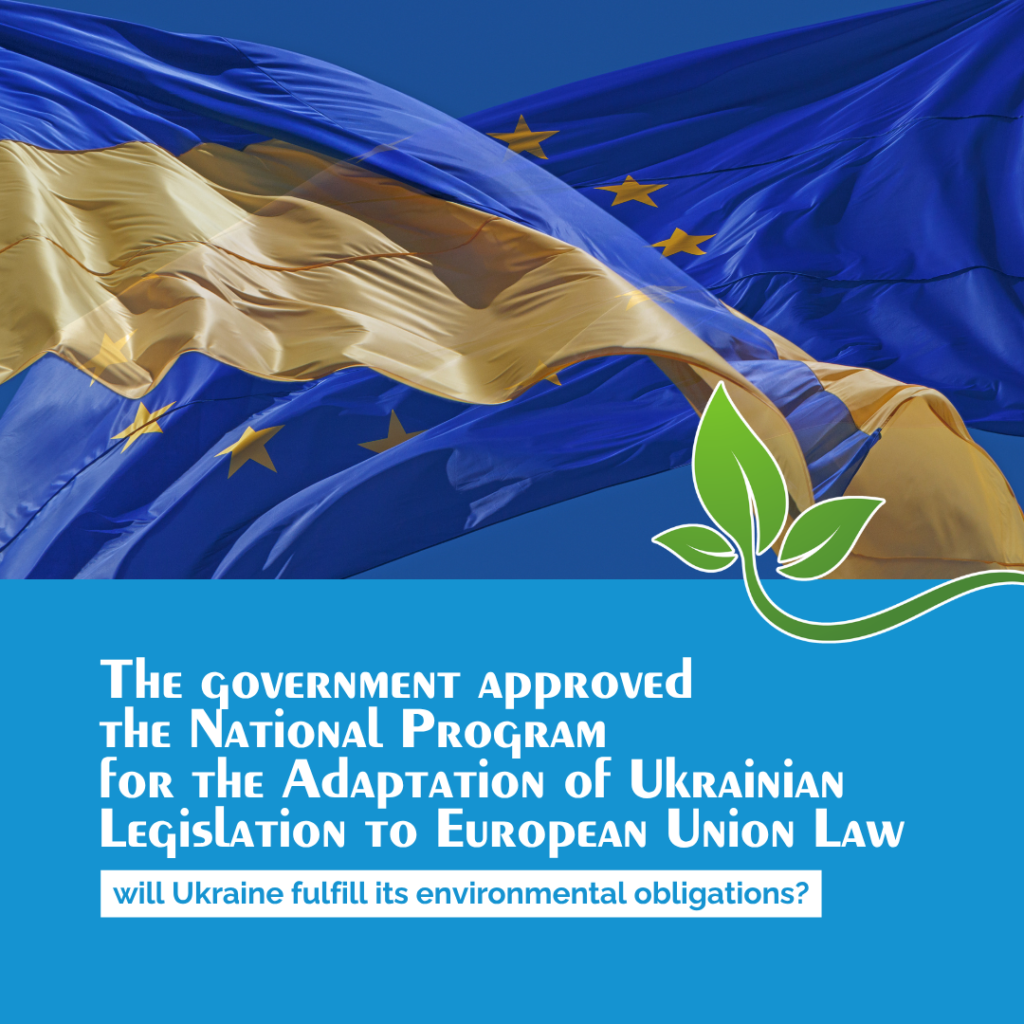
On April 1, 2026, the Cabinet of Ministers of Ukraine adopted Resolution No. 438, by which it approved National Program for the Adaptation of Ukrainian Legislation to European Union Law (EU acquis) (hereinafter – the Program). This document is an important element of the negotiation process on Ukraine’s accession to the EU and actually determines what exactly and within what time frame the state must do to transpose and implement EU law in Ukraine. The Program covers about 1,850 tasks and provides for the implementation of over 1,600 acts of EU law. It is structured according to the negotiation clusters and chapters, integrates recommendations of the European Commission.
The government declares that the Program takes into account the so-called “benchmarks”, the fulfillment of which is a prerequisite for closing the negotiation chapters, and full adaptation of the legislation will be completed by 2027. However, an analysis of the content of the Program, in particular in the field of the environment, gives reason to doubt the realism of such statements.
Chapter 27 “Environment and Climate Change” is traditionally one of the most difficult in the process of European integration. The Program confirms that Ukraine has already achieved some progress, in particular in the implementation of environmental impact assessment and strategic environmental assessment procedures, in the development of a geospatial data system. However, in most environmental subsectors, still there is only partial compliance with EU law.
In particular, Ukrainian legislation still does not meet EU requirements in the field of environmental liability, which actually makes impossible full implementation of the “polluter pays” principle. In the area of air quality, Ukraine has only partially implemented the basic directives and has a low level of compliance with new, stricter EU standards. In the area of waste management, there is also a lack of key legislative solutions, in particular on single-use plastic products, and the necessary infrastructure for implementing the circular economy policy has not been created.
A similar situation is observed in the area of water policy: despite the formal approximation to Directive 2000/60/EC of the European Parliament and of the Council of 23 October 2000 establishing a framework for Community action in the field of water policy (hereinafter referred to as Directive 2000/60/EC), significant challenges in the field of wastewater treatment, water monitoring and control still remain serious.
Special attention should be paid to the provisions of Cluster 1 “Fundamentals of the EU accession process”, which, despite their systemic focus, are also of direct importance for environmental policy. This concerns, in particular, the need to introduce environmental and economic accounts – a tool that allows integrating environmental indicators into the system of national statistics and economic planning. The formation of accounts of environmental taxes, goods and services, as well as environmental subsidies is critically important for the transition to the proper application of the “polluter pays” principle. At the same time, this task requires not only technical preparation, but also effective interdepartmental coordination and establishment of regular data transmission to Eurostat, which currently remains a challenge for Ukraine.
Moreover, the provisions of Chapter 21 “Trans-European Networks” in the Program demonstrate that integration into EU infrastructure policy is also closely linked to environmental requirements. Implementation of projects within CEF mechanism, implementation of TEN-T regulation and strengthening financial control through OLAF instruments have not only economic but also environmental significance, as they envisage compliance with standards of sustainable development, environmental impact assessment and proper resource management. This emphasizes the fact that the environmental component is integral to all key areas of European integration process, and is not limited to Chapter 27.
Based on the above, setting a deadline of 2027 for completing the adaptation of Ukrainian legislation to the standards of the EU acquis seems politically understandable, but from a practical point of view is extremely difficult to achieve.
As a positive step can be viewed the inclusion in the Program of measures to adopt the Law of Ukraine on Amendments to Certain Legislative Acts of Ukraine to Ensure the Implementation of International Obligations under the Aarhus Convention by December 2026. This law is necessary to implement the decision of the Meeting of the Parties to the Aarhus Convention, which recognized Ukraine as a violator of its obligations under this international treaty in terms of access to information and public participation in production-sharing agreements.
Remote deadlines for the Habitats and Birds Directives transposition raise particular concern among the public. In particular, the Programme postpones the adoption of the legislative framework for Natura 2000 sites until 2030. At the same time, Benchmark 27.6 announced to Ukraine provides that even before accession to the EU, Ukraine must adopt relevant legislation, submit a list of proposed Natura 2000 sites to the European Commission, grant these sites protected status, implement the necessary conservation measures, and generally demonstrate full readiness to ensure compliance with the requirements of the EU acquis in the area of nature conservation by the date of accession. It is obvious that under the conditions of the postponement of the Natura 2000 legislation, the implementation of Benchmark 27.6 is out of the question, because it takes about 6 years to apply all its operational provisions in practice.since the moment of adoption of such a law.
Moreover, these EU legal acts are fundamental among environmental acquis of the Community, and other interrelated elements of the EU environmental law are based on them. Key concepts such as “habitat”, “protected species”, “special protected areas” and the mechanisms, in particular, appropriate assessment, defined by them are used throughout by other EU acts in environmental and other related areas (in particular, in the areas of energy, infrastructure development and transport). Without their implementation, the full transposition of other acts that rely on these concepts and mechanisms will remain impossible.
It is also critical that in the area of environmental liability and criminal protection of the environment, a much shorter deadline has been set – until 2027. As a result, there is a risk of a situation in which legal liability mechanisms will be formally introduced before establishment of the legal framework and the system of protected areas and their management. This contradicts the logic of the EU acquis, within which preventive, management and punitive mechanisms should be implemented in a coordinated, gradual and interconnected manner.
It should also be taken into account that Directive 2024/1203 on the protection of the environment through criminal law, is new. It significantly expands the list of environmental crimes compared to its predecessor, strengthens the requirements for the types and grounds of criminal liability, as well as the standards of law enforcement, which objectively creates a significant burden on the national legal systems of the Member States. In this context, the establishment of shortened implementation deadlines for Ukraine (until 2027) seems pointless, since it implies the need for simultaneous catch-up (in terms of the previous Directive on environmental crimes) and partially advance (in terms of the updated Directive) implementation of complex legal instruments. Thus, we have a situation when Ukraine plans to implement this instrument faster than some of the EU Member States. This, in turn, increases the risk of formal accelerated transposition without due consideration of the practice of applying EU law and the level of institutional readiness, which may negatively affect the effectiveness of environmental protection in Ukraine through criminal law.
It is important to understand that a significant part of the EU environmental acquis requires large-scale investments. This includes the modernization of water infrastructure, the creation of waste management systems, and the development of air and water quality monitoring networks. Without adequate funding, these requirements cannot be met in the short term. Therefore, the Programme provides for the possibility of applying transitional periods in a number of sectors, which effectively recognizes that full implementation of individual directives within a given period is impossible. To sum up, this suggests that 2027 should be seen as a political benchmark rather than a realistic deadline for achieving full compliance with EU environmental law.
The positive thing is that the Program offers a systematic approach: it clearly defines the list of EU acts, the deadlines for their implementation and responsible executors, and also provides for mechanisms of implementation monitoring. At the same time, the experience of implementing environmental legislation in Ukraine shows that the formal transposition of EU norms does not always guarantee their effective action in practice. Without proper institutional support, transparent procedures, public access to information and justice, and effective state control, the environmental norms risk remaining declarative.
Thus, it is not only about the need to adopt new regulatory acts, but about a deep transformation of the entire system of environmental governance. Therefore, special attention should be paid to the institutional capacity of authorities. The Program directly indicates the need to create new monitoring systems, laboratories, coordination mechanisms and data exchange. Today, these elements are either absent or function in a limited way, which creates serious risks for the implementation of obligations.
In addition, the full-scale war continues to significantly impact the state’s capacity to implement environmental policy, particularly in terms of environmental monitoring and infrastructure development.
The approval of the National Program for the Adaptation of Legislation to EU Law is an important and necessary step on the path to Ukraine’s membership in the European Union. The document creates a framework for systematic work and allows structuring the process of implementing the EU acquis. At the same time, in the environmental sphere, the key challenges are related to realistic deadlines, significant financial burden and institutional capacity of the state. Without proper emphasis on high-quality transposition and practical application of environmental legislation, there is a risk that adaptation will remain largely formal. That is why, at this stage, it is important to focus not only on the speed of decision-making, but also on their quality and ability to ensure real changes for the environment and people.