
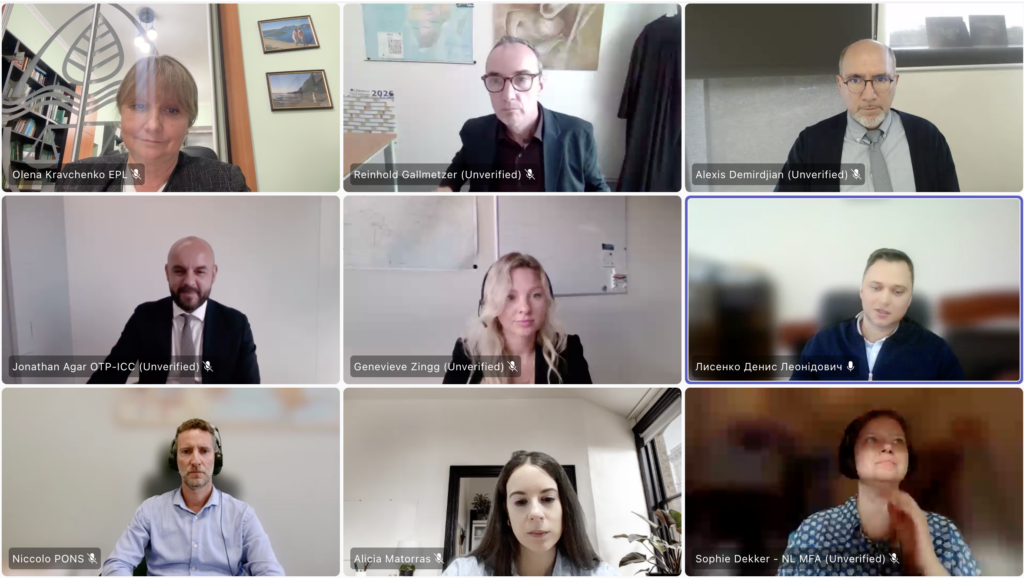
Yesterday, a meeting of the Dialogue Group on Responsibility for Events in Ukraine took place focusing on actions of regional and international institutions.
The Dalogue Group includes representatives of the International Criminal Court, the Prosecutor General’s Office of Ukraine, scientists, civil society experts from the EU, Latin America, etc.
The Dialogue Group session was dedicated to the topic of environmental crimes. The organizers set the goal of this session to exchange experiences of key stakeholders to jointly develop ways to strengthen cooperation between international and regional organizations, national authorities, and civil society experts working on studying the impact of military actions on the environment.
In accordance with the overall goal, the Dialogue Group defined the following objectives for the meeting:
• reducing information gaps between key accountability actors regarding initiatives currently being implemented to document and investigate environmental damage in Ukraine;
• highlighting positive examples to further strengthen coordination between international, national and non-governmental environmental organizations in this area of work;
• identifying and supporting common priorities in the work of all participants to encourage focused collective efforts in addressing the problem of environmental damage in Ukraine.
The co-chairs of the Dialogue Group on Responsibility for Events in Ukraine – representative of the Prosecutor General’s Office of Ukraine Denys Lysenko and representative of the International Criminal Court Prosecutor’s Office Jonathan Edgar delivered introductory remarks, outlining the purpose and objectives of the Dialogue Group meeting.
The speakers then presented a series of presentations to lay the groundwork for further discussion of environmental crime issues in Ukraine.
In particular, representatives of the International Criminal Court Prosecutor’s Office spoke,
including Reinhold Hallmetzer, attorney and leader of the ICC Prosecutor’s Office’s Policy on Addressing Environmental Damage through the Rome Statute, Alexis Demirjian, Joint Team of the Prosecutor’s Office in Ukraine, who in their speech outlined recent developments in the Office’s policy framework on environmental crimes; and highlighted the potential relevance of this renewed approach to the situation in Ukraine. Reinhold Hallmetzer particularly focused on the work of the coalition of researchers and environmental community representatives who developed a policy on responding to environmental damage under the Rome Statute that for the first time systematically integrates environmental damage into the framework of the International Criminal Law. Althoug the Rome Statute of the ICC (hereinafter referred to as the Statute) does not establish a separate crime of ecocide, the very fact of the release of this document significantly changes how the ICC and states will interpret the crimes provided for in the Rome Statute.
A detailed analysis of this policy can be found in our publication on EPL’s website: https://epl.org.ua/wp-content/uploads/2025/12/ISTORYCHNYY-KROK-MKS-Polityka-2-2.pdf
Vladyslav Ihnatenko, prosecutor from Specialized Environmental Prosecutor’s Office (SEP) of the Prosecutor General’s Office of Ukraine, in his report outlined the range of criminal proceedings under Article 441 “Ecocide” and focused in detail on the cases of the Kakhovka Dam explosion and the attempted explosion of the National Scientific Center “Kharkiv Institute of Physics and Technology”. In his report, Mr. Vladyslav named a number of problems in the work of the SEP. These include the weak institutional capacity of the State Ecological Inspectorate, the lack of a biodiversity monitoring system, the lack of modern methods for recording the impact of military actions on the environment and calculating the damage caused to ecosystems and its parts, the lack of systematic cooperation between the Prosecutor General’s Office, the Academy of Sciences of Ukraine, the State Environmental Inspectorate, etc.
EPL Executive Director Olena Kravchenko focused her presentation on the prospects for cooperation between the expert community of civil society with the Prosecutor General’s Office of Ukraine, the International Registry of Damages, SEI, the State Emergency Service, and the Ministry of Defense of Ukraine in studying the impact of military actions on nature. Olena also outlined the goal of the organization’s activities on the impact of military actions on nature:
1. Become a voice for the silent victim of war.
2. Verify the state’s institutional and legal capacity to collect facts, establish causal relationships, and assess the damage caused.
3. Test the legal system and identify gaps at both the national and international levels.
Olena outlined the main stages of activities to document environmental damage and, together with EPL’s leading scientific expert Kateryna Polyanska, divided the organization’s work into three key stages:
2014–2022 — Establishing expertise in documenting the environmental impacts of armed conflict. Study of the environmental impacts of armed conflict in the occupied territories of Donetsk and Luhansk region and the Autonomous Republic of Crimea.
Initiation of research into chemical contamination of natural ecosystems resulting from hostilities. Preparation of two methodological guides.
Study of the impacts of armed conflict on the territories and sites of Ukraine’s protected areas.
2022 — Launch of systematic research into the impacts of armed conflict on Ukraine’s natural ecosystems. Establishment of EPL’s database on the environmental impacts of the war and systematic collection of information on environmental harm caused by hostilities.
Launch of field expeditions along the frontline and to de-occupied territories in Kyiv, Chernihiv, Donetsk, Kharkiv, Mykolaiv and Kherson regions.
2023–2025 — Continued field expeditions in Sumy, Kherson, Odesa, Dnipropetrovsk, Donetsk, Zaporizhzhia and Kyiv regions. Assessment of the environmental consequences of the destruction of the Kakhovka Dam, including the collection of sediment samples from the former reservoir bed.
Cooperation with leading Ukrainian laboratories to identify contaminants in soil samples and samples associated with damaged military equipment, burned materials, oil spills and rocket propellant residues. Cooperation with the national nature parks “Kamianska Sich”, “Tuzlivski Lagoons”, “Holy Mountains” and “Desniansko-Starohutskyi” , and the “Khortytsia” National Historical and Cultural Reserve.
Biotope mapping to establish baseline conditions and assess damage to six national nature parks. Cooperation with local communities; development of environmental components of recovery plans for five communities and methodological recommendations.
2025–2026 — Continued assessment of the consequences of the destruction of the Kakhovka Dam and the recovery of the Velykyi Luh ecosystems. Research into the impacts of armed conflict on coastal and marine ecosystems, including the initiation of studies of deceased cetaceans.
Refinement of methodologies for assessing soil contamination and initiation of research into the migration of contaminants into vegetation. Current work: development of Environmental Principles for Humanitarian Demining of Natural Areas.
Over the years, more than 40 field expeditions have been conducted in all natural zones of Ukraine – along the front line and in areas affected by hostilities, more than 1 ton of soil samples, debris and striking elements have been collected to assess the impact of the armed conflict on the environment, and to assess pollution and other consequences related to missile, bomb, mine strikes, use of cluster munitions and other types of attacks. The assessment also covered destruction and burning of military equipment; spills of fuel and lubricants; accumulation of debris and waste due to destruction. An assessment of potential environmental risks associated with these consequences was carried out, recommendations were developed to eliminate and minimize the identified risks.
In the period of 2024-2026, EPL has been testing the national judicial system and initiated legal proceedings to recover compensation for environmental damage. During this time, EPL initiated 4 legal cases to protect public interests and recover compensation for environmental damage.
The defendant in these cases is the Ministry of Foreign Affairs of the Russian Federation. The plaintiffs in the commercial and civil lawsuits are EPL, national natural parks, and the State Environmental Inspectorate. The trials are ongoing.
As mentioned by EPL’s executive director, EPL started cooperation with representatives of the International Register of Damage in Kyiv, which is a result of systematic work to study the impact of military actions on the environment,
On September 30, 2026, the Register was fully opened for submissions in all 43 categories.
The following categories were the last to be opened for submission:
B3.1 – Environmental damage, and
B3.2 – Pillaging and/or appropriation of natural resources.
Environmental damage compensable under category B3.1 includes any adverse impact on fauna, flora, soil, water, air, ecosystems formed by these elements, landscape features, and natural resources, or on the interactions between these factors. This category also encompasses natural elements that are—or may be—the result of human intervention, including, but not limited to, food products, agricultural land, drinking water, and domestic animals.
However, at the national level, the state has restricted civil society organizations (as legal entities), local self-government bodies, and nature reserve fund sites from acting as claimants in this category.
The claim submission procedure for this category lacks clarity and requires further refinement.
Summing up her report, Olena noted that the systematic work on studying the impact of military actions on the environment for 12 years has shown systemic problems from collecting evidence to their analysis, calculation, development of a unified strategy at the state level, strengthening institutional capacity in the work on studying the impact of military actions on the environment. In particular, Ukraine needs a modern, effective central body of environmental control, which should have the institutional capacity for systematic and verified collection of information, Ukraine needs to develop modern methods of collecting evidence and calculating damages, which fully take into account the challenges of today, caused by the total destruction of the environment. For Ukraine, it is critically important to ensure coordinated actions between the Prosecutor General’s Office of Ukraine, the State Environmental Inspectorate, the State Emergency Service, the Ministry of Defense of Ukraine, the National Academy of Sciences of Ukraine, civil society experts and international specialists. Only such synergy will be the key to overcoming the challenges described above.
The participants of the Dialogue Group on Responsibility for Events in Ukraine discussed in detail each of the challenges described above and decided to include representatives of the Ukrainian civil society expert community, scientists from the Academy of Science of Ukraine, and representatives of state bodies in the working group that developed the Policy on Addressing Environmental Damage through the Rome Statute in order to strengthen all stakeholders in Ukraine studying the impact of military actions on the environment to jointly develop a plan to improve all stages of work with environmental crimes in Ukraine and its implementation.

This publication was compiled with the support of the International Renaissance Foundation. Its content is the exclusive responsibility of the authors and does not necessarily reflect the views of the International Renaissance Foundation.
