
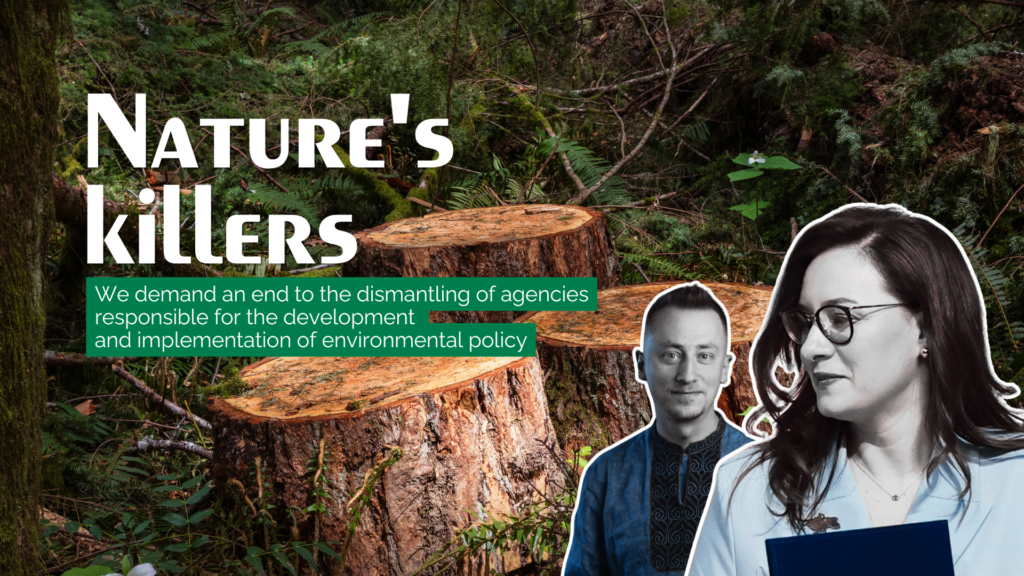
The Cabinet of Ministers of Ukraine’s preparation of a draft resolution “On the Optimization of the System of Central Executive Bodies,” which calls for the elimination of a number of agencies in the field of natural resource management, has raised legitimate concerns among civil society and experts.
This is not the first time that, under the guise of so-called “optimization,” institutions responsible for the formulation and implementation of environmental policy have been weakened or eliminated. This draft resolution not only continues this practice but effectively takes it to the extreme—the systematic dismantling of environmental governance bodies.
The draft resolution provides for:
Liquidation of the State Agency of Water Resources of Ukraine and the State Service of Geology and Subsoil of Ukraine, and the transfer of their functions to the State Agency for Nature Management.
Liquidation of the State Agency of Ukraine for Land Reclamation, Fisheries, and Food Programs and the transfer of its functions to the State Agency for Biodiversity.
Renaming of the State Service of Ukraine for Geodesy, Cartography, and Cadastre to the State Agency for Nature Management with a significant expansion of its powers.
Renaming the State Agency of Ukraine for Forest Resources to the State Agency for Biodiversity.
Further amendments to legislation following the actual liquidation of the agencies.
Further “optimization” of the system of executive authorities through their merger, accession or liquidation.
We consider this approach unacceptable, as it has neither managerial nor legal logic, leads to a chaotic layering of functions within two agencies, and destroys the integrity of state governance in the field of environmental protection. This approach deepens the degradation of governance in the field of environmental protection and the use of natural resources, which was exacerbated by the merger of the Ministry of Environment, the Ministry of Economy, and the Ministry of Agrarian Policy. At the same time, this approach in no way solves the problem of the lack of institutional capacity of the state to organize work on the preservation and restoration of biodiversity.
Each of the bodies subject to liquidation performs clearly defined functions in a specific area of use of environmental elements – water bodies and aquatic bioresources, subsoil. It is this functional specialization that ensures the appropriate level of expertise, consistency of state policy and effectiveness of management decisions.
The transfer of these disparate functions to two bodies with blurred and artificially expanded powers — “nature management” and “biodiversity” — will inevitably lead to a loss of professional specialization, a decrease in the quality of management, and a dilution of powers. In such a model, neither of the areas of management will have the proper institutional capacity.
In fact, this draft resolution does not concern the creation of a new and effective system of central executive bodies in the field of environmental governance, but a mechanical redistribution of functions between two renamed bodies. It should be emphasized that the environmental sphere has not yet “recovered” from the extremely ill-considered reform of the creation of a hybrid Ministry of Economy. Therefore, the proposed changes have a chance to create long-term obstacles in European integration reforms and obstacles for honest business, which will lose time and money as a result of such reforms.
Combining functions in the field of land use, water resources, and subsoil in one agency means excessive and dangerous concentration of powers in the areas most vulnerable to corruption, which in turn opens up opportunities for non-transparent allocation of resources, political influence, and abuse.
At the same time, the transformation of the forest Central Executive Agency into a biodiversity agency with the simultaneous addition of functions in the field of land reclamation and fisheries to it looks like an artificial and internally contradictory construction. After all, in recent years, the public has rejected many anti-forestry initiatives and draft laws that were born in the State Forestry Agency and the State Fisheries Agency, so biodiversity protection will become an unnecessary burden in this agency.
It is worth noting that land reclamation is not only an economic activity, but also an important environmental function related to the state of aquatic ecosystems. Its inclusion into a agency formed on the basis of the forestry agency indicates the lack of a systematic approach to environmental management.
As a result, a model is formed in which the functions of using natural resources and their protection are artificially divided between different bodies without proper balance, which creates a conflict of interests.
Of particular concern is the absence in the proposed model of a clearly defined body responsible for the implementation of the functions of managing the NPF objects and comprehensive implementation of Ukraine’s obligations in the field of biodiversity conservation, in particular regarding the implementation of approaches similar to the Natura 2000 network.
In the proposed version, the State Agency for Biodiversity will have nothing to do with the state’s functions in preserving and restoring biodiversity, but will only serve as a cover for even more intensive use of natural resources.
We would like to emphasize separately: the draft resolution first provides for the liquidation of bodies, and only then for amendments to the legislation, which contradicts the principle of legal certainty.
The instruction to the ministries to further “optimize” the Central Water Resources Agency confirms the lack of a holistic reform concept and paves the way for further destruction of modern environmental governance. It should be recalled that attempts to eliminate the State Water Agency have already taken place, but they were unsuccessful. It is also important to maintain the sustainability of water monitoring, preservation of insufficient water resources in the context of the climate crisis and the Russian Federation’s attacks on water bodies in Ukraine.
The proposed changes contradict Ukraine’s obligations under the EU-Ukraine Association Agreement. The weakening of the institutions responsible for their implementation directly undermines Ukraine’s European integration course. The liquidation of the State Agency for Water Resources of Ukraine jeopardizes the implementation of the basin principle of water management – a key element of the European Union’s water policy. The liquidation of the State Service for Geology and Subsoil of Ukraine creates risks of losing control over the state’s strategic resources, which is especially dangerous in the context of post-war reconstruction.
In Ukraine, there have already been attempts to combine the functions of implementing state policy on the conservation and use of natural resources in one executive body, when by Decree of the President of Ukraine dated 10.02.2004 No. 177/2004 the authority to ensure implementation of state policy in the field of geological study and rational use of subsoil, topographic and geodetic, cartographic activities and nature reserves, formation of a national ecological network, was transferred to State Committee for Natural Resources. This body, headed by M. Zlochevsky, was created to implement corruption schemes for the use of natural resources and was liquidated after the Orange Revolution in 2005.
Taking into account the above, the provisions of the draft resolution pose a direct threat to the environmental security of the state and the sustainable development and green reconstruction of Ukraine. Ultimately, this indicates not optimization, but the purposeful destruction of the environmental governance system.
We demand:
an immediate halt to the advancement of the draft resolution;
that the dissolution of specialized environmental agencies be prevented;
that open consultations with the public and the expert community be ensured;
that a systematic reform of environmental governance be developed, one that guarantees the strengthening of institutions rather than their dissolution.
International charitable organization ”Environment-People-Law”
Charitable Organization “Nature Fund of Ukraine”
NGO “Ukrainian Nature Conservation Group”
Resource and Analytical Center “Society and Environment”
NGO “Bee City”
NGO “Save Pikuy,” Chairperson Nataliia Vyshnevska
MK “Joint Actions”
ICO IC“Green Dossier”
NGO “ National Interests Advocacy Network‘ANTS’”
NGO “Forest Initiatives and Society”
NGO “Ecosphere”
NGO “Eco-Club”
MGEU “Our Home – Manyava”
NGO “Ekoltava”
NGO “Mariupol Zero Waste”
NGO “Ekodia”
NGO “Zero Waste Society”
NGO “Zero Waste Lutsk”
NGO “Osokorky Ecopark”
NGO “Environmental Humanitarian Association “Green World”
NGO “Plato”
NGO “Bureau of Environmental Investigations”
NGO “UEC ‘Green Wave’”
NGO “Network of Eco-Stations of Ukraine”
NGO “Black Sea Women’s Club”
EGO “MAMA-86”, Donetsk Region
NGO “Desnyanski Zori”
NGO “All-Ukrainian League of Lawyers Against Corruption”
Researcher at the National Nature Park “Homilshanskiy Forests” Volodymyr Timoshenkov
Senior Researcher at the National Nature Park “Homilshanskiy Forests” Valentina Timoshenkova
Iryna Vykhrystiuk, Director of the National Nature Park “Tuzlivski Lymany”
NGO “Revival of Natural Heritage”
NGO “Zero Waste Zaporizhzhia”
NGO “EcoNews”
NGO “Ecological Club ”Krai“”
Ecological Club “Pechenihy”
Mykola Klyuyko
UEA “Green World”
NGO “Youth Climate Initiative Rozviy”
NGO “ECO ‘Mizhrichynska Pushcha’”
NGO “EcoTEKA”
NGO “CHYSTO.DE”
NGO “Eremurus Environmental Club”
NGO “FORZA”
Donetsk Regional Branch of the All-Ukrainian Environmental League
World Wildlife Fund, Ukraine
