
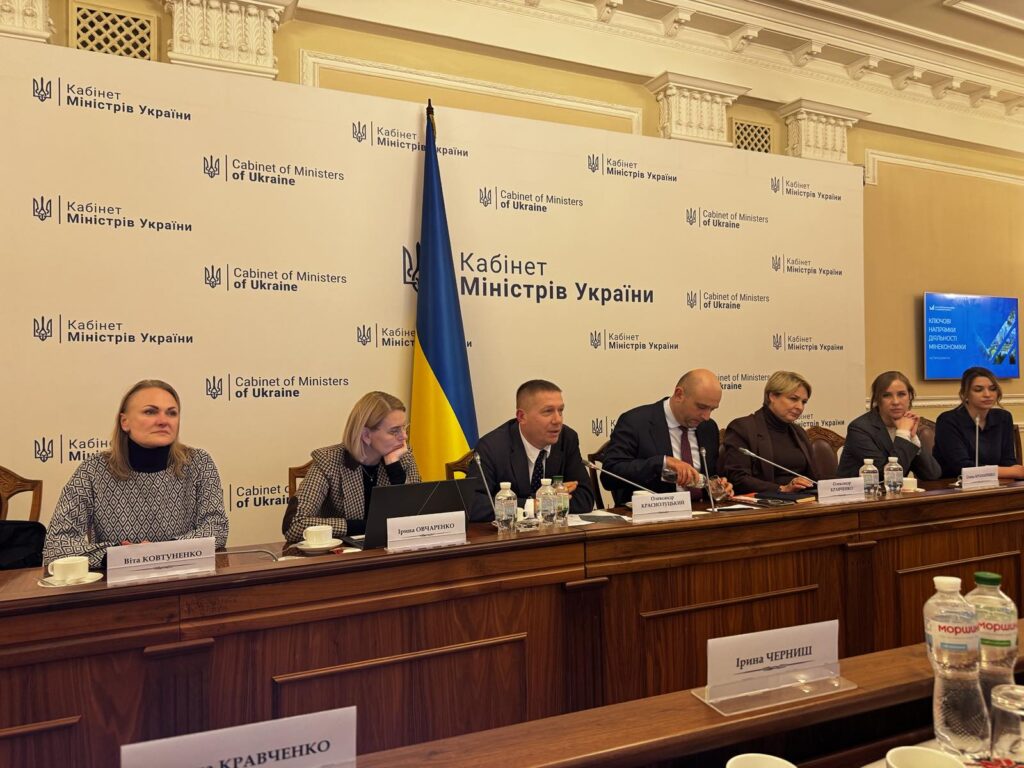
Recently, representatives of EPL team participated in a meeting between the leadership of the Ministry of Economy and Environmental Protection of Ukraine and representatives of the civil society environmental movement.
The meeting began with a presentation by Minister Oleksandr Kravchenko of the work plans of the Ministry of Economy for 2026-2027. In his speech, the Minister assured of the immutability and importance of the country’s direction towards climate neutrality in 2050, and of the introduction of a systematic dialogue with the European Commission on CBAM issues.
The Minister drew attention to the need to reform the state environmental control system, state monitoring of air quality, and legal liability for environmental crimes. The Minister noted the importance of sectoral reforms. In particular, in 2026-2027, draft laws on the national system of greenhouse gas emission quota trading, on the taxonomy of environmentally sustainable economic activity and promotion of environmentally sustainable investment should be developed. Methodologies for implementing environmental assessments should be improved. The territory of the nature reserve fund should be expanded and a law on conservation areas should be adopted.
In her speech, EPL Executive Director Olena Kravchenko noted that the transposition and implementation of 210 directives and regulations requires a modern European environmental governance architecture. Such a governance architecture requires a separate Ministry of Environmental Protection, a number of agencies and inspections under the leadership of a relevant ministry, an increase in the number of employees, a logical structure of the ministry that would meet the tasks and challenges of achieving 11 benchmarks, and the implementation of tasks of Chapter 27 “Environment and Climate Change” of the acquis. Olena noted that EPL conducted a thorough analytical study of the institutional capacity of the sphere of environmental protection and preservation from central authorities to local self-government bodies of territorial communities and submitted a paper version of the study to the ministry’s leadership. The electronic version can be found here: https://bit.ly/4zumYnG.
Olena noted that the successful transposition and implementation of the Bird and Habitat Directives cannot be implemented qualitatively without an expanded biodiversity conservation department or a separate nature conservation agency in general, and emphasized that a separate analytical study on the institutional capacity for the protection and conservation of biodiversity was conducted jointly with colleagues from UNCG and the Agency for Nature Conservation of the Czech Republic. A paper version of the study was submitted to the leadership of the ministry. The electronic version can be found here: https://bit.ly/4znqmAz.
Olena Kravchenko also reminded that Ukraine’s fulfillment of its obligations under international environmental agreements is also part of the European integration tasks, and such tasks have not been the focus of the Ministry recently. Since October 2022, Ukraine has not implemented the decision of the Meeting of the Parties to the Aarhus Convention, which EPL has repeatedly reminded about. You can read more about the decision of the Meeting of the Parties here: https://bit.ly/4BWZGZh.
Senior analyst, environmental scientist of EPL Kateryna Polyanska began her speech with the information on National Nature Park “Kamianska Sich” in Kherson region and its team, which continues to work courageously during the war to preserve nature. The Minister was presented with a publication dedicated to these events: https://epl.org.ua/human-posts/natsionalnyj-pryrodnyj-park-kam-yanska-sich-vijna-proty-pry-rody/.
The second part of the speech was dedicated to preservation of the highlands of the Ukrainian Carpathians from destruction by wind turbines. Kateryna drew attention to the destruction of the Runa valley, the slopes of Mount Hostra, Mount Pikuy, threats to the Svydovets ridge and the Borzhava valley, plans to build 300 windmills and threats to Carpathian ecosystems. The development of renewable energy should not destroy relict and unique natural complexes, virgin forests, alpine meadows, rare species of plants and animals, the natural heritage of Ukraine. The highlands in the Ukrainian Carpathians occupy less than 1% of the territory of our state.
Kateryna asked the minister why Ukraine cannot follow the example of other European countries and consider as alternative territories for the construction of wind farms plains, degraded lands, agricultural lands, territories that are close to roads and power grids and do not require significant capital investments, in particular,do not require construction of new roads in highland conditions, the laying of new power lines, deforestation, destruction of meadows and natural watercourses. The practice of the European Union shows that highlands are not a typical area for the development of wind energy. Of the 129,579 analyzed wind turbines, only 8.7% are located at altitudes above 1000 m, while almost three quarters (72.8%) are installed below 500 m above sea level.
The environmental scientist read out the demands and handed over paper copies of the statement to both the minister and the relevant deputy. In particular, Kateryna noted that civil society environmental activists demand to develop and adopt legislative amendments aimed at introducing a moratorium on the placement of wind farms (WPPs) on mountain peaks and ridges of the Carpathians at altitudes above 1000 m, stop the construction of WPPs on the Runa valley, promote the creation and expansion of existing territories of the nature reserve fund, in particular through the implementation of the environmental initiatives “Free Svydovets”, “Polonyna Krasna”, the expansion of the Verkhovynskyi National Nature Park and other valuable natural territories of the Carpathians. It is important to resume movement towards Ukraine achieving a reserve indicator of 30% of the state’s area, abolish restrictions on inspections by the State Environmental Inspectorate of business entities in territories where active hostilities are not underway, etc. The full text of the open appeal can be found here:
Overall, during the meeting, representatives of environmental civil society movement raised a significant layer of problems: from horizontal reforms to sectoral ones: institutional capacity to form and implement environmental protection policy, weak capacity and political will to carry out reforms of the state environmental control system, monitoring, protection and conservation of nature, waste management, formation of an adequate policy for implementation of projects in the area of renewable energy, nuclear safety, animal cruelty, introduction of a moratorium on peat and amber extraction, etc.
We hope that representatives of environmental civil society movement have been heard, and that the meetings will become systematic, thematic, and will bring a common result in promoting environmental reforms.
